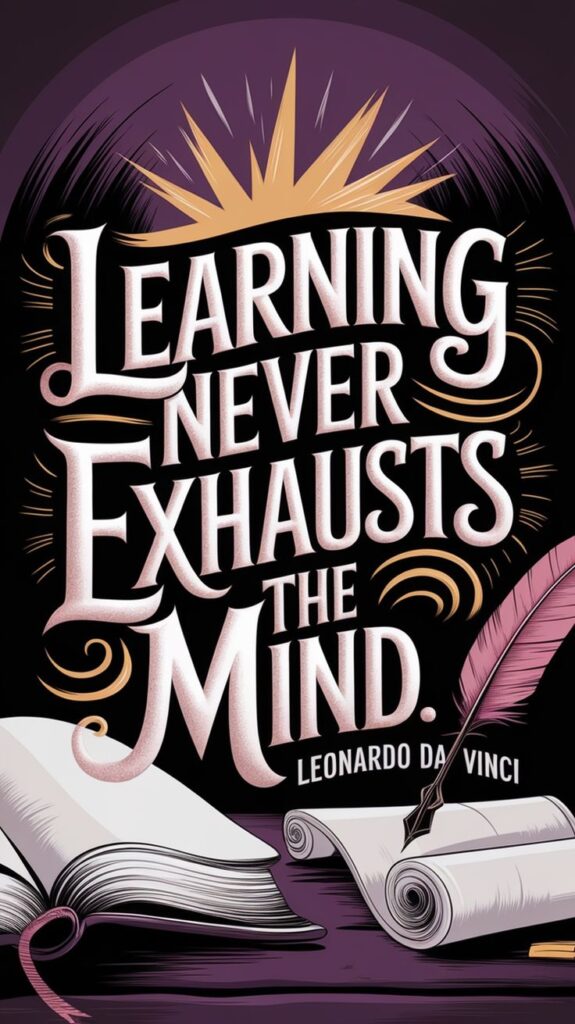
The Eternal Flame of Curiosity and the Human Drive to Grow
“Learning never exhausts the mind.” These six simple words by Leonardo da Vinci offer profound insight into the very core of human nature and potential. More than a quote, it is a philosophical truth—a beacon for all seekers of knowledge and growth. Leonardo da Vinci, a man of boundless curiosity and genius, knew something that modern science now affirms: the act of learning is not a burden, but a renewal. When we genuinely learn, we feed the mind rather than fatigue it.
In a world that often confuses busyness with productivity and noise with progress, da Vinci’s quote calls us back to something fundamental: the joy of intellectual discovery. This article explores the deeper meaning of the quote, the neuroscience behind learning, historical and contemporary examples of lifelong learners, and how embracing this mindset can transform both individual lives and society as a whole.
The Meaning Behind the Quote
When da Vinci says that learning doesn’t exhaust the mind, he is not denying that effort is involved. Rather, he suggests that learning is not the type of effort that drains; it is the kind that energizes. Learning involves a different kind of exertion—one that activates rather than depletes.
This is particularly evident when one is deeply engaged with a subject of genuine interest. We lose track of time. We enter a state of “flow,” a concept popularized by psychologist Mihály Csíkszentmihályi, where the mind is fully immersed and invigorated. In such moments, mental fatigue does not arise in the usual way. Instead, we feel fulfilled, even exhilarated. The mind, far from being exhausted, is stretched and strengthened.
Leonardo da Vinci: The Ideal Embodiment
Leonardo da Vinci lived by the truth of his own quote. He was not only a painter but also a scientist, engineer, anatomist, musician, and inventor. His notebooks—filled with anatomical sketches, engineering diagrams, philosophical musings, and scientific observations—demonstrate a mind that never ceased to explore.
His tireless pursuit of knowledge across disciplines was not driven by the desire for fame or wealth, but by pure curiosity. For da Vinci, the world was a puzzle waiting to be understood. His intellectual hunger kept him mentally youthful, even as he aged physically. He saw no boundary between art and science, between observation and imagination.
In this way, da Vinci personifies what it means to live with a mind that is always learning. And he demonstrates that the act of learning itself becomes a source of vitality.
The Neuroscience of Learning and Mental Energy
Modern neuroscience supports da Vinci’s assertion. Contrary to the belief that mental effort depletes energy in a way comparable to physical labor, learning actually stimulates and strengthens the brain.
Neuroplasticity—the brain’s ability to reorganize itself by forming new neural connections—continues throughout life. When we learn new things, especially in meaningful or novel ways, our brains respond by building new pathways. Far from exhausting the mind, learning keeps it agile and adaptable.
Moreover, engaging in active learning stimulates the release of dopamine—the “feel-good” neurotransmitter associated with pleasure, motivation, and reward. This neurochemical response reinforces the idea that learning is not only useful but deeply satisfying.
Historical and Modern Examples of Lifelong Learners
Da Vinci was not alone in his pursuit of knowledge. Many of history’s great thinkers and creators embodied the principle that learning fuels the mind.
Socrates, despite having no formal school or writings of his own, devoted his life to questioning, observing, and conversing. His famous assertion—”The unexamined life is not worth living”—mirrors da Vinci’s sentiment.
Benjamin Franklin, another polymath, was largely self-taught and continuously expanded his knowledge throughout life. He believed in “improving the mind by reading, writing, and conversing.”
Maya Angelou, the celebrated poet and activist, learned several languages, wrote across many genres, and worked in multiple professions. She once said, “I am always learning. I am still learning.”
In contemporary times, Elon Musk has exemplified this idea by mastering disciplines like software engineering, rocketry, automotive design, and artificial intelligence—not through degrees but through aggressive self-learning.
These individuals show that far from exhausting us, learning invigorates our purpose, widens our influence, and sharpens our vision.
Learning as a Source of Emotional and Spiritual Fulfillment
The benefits of learning are not confined to the mind alone. Learning fosters emotional resilience and spiritual growth.
When we learn new things—whether languages, musical instruments, or philosophical ideas—we stretch our identities. We realize we are more capable than we thought. This builds confidence and cultivates a sense of expansion. It also diminishes fear, because the more we understand, the less we are afraid.
Learning gives meaning to struggle. Whether it’s a new skill after failure, a deeper understanding of human relationships, or a discovery in science, every piece of new knowledge can be redemptive.
Spiritual traditions around the world emphasize the idea of inner growth and enlightenment. Learning serves as a bridge to that spiritual elevation. It opens the heart and mind to the mystery of existence and connects us with something larger than ourselves.
Learning in the Age of Information
We now live in an era where knowledge is more accessible than ever before. Online platforms, digital libraries, free courses, podcasts, and videos allow anyone with an internet connection to dive into nearly any subject imaginable.
And yet, despite this access, many people feel mentally fatigued and overstimulated. This paradox reveals an important distinction: consuming information is not the same as learning.
True learning requires attention, reflection, and integration. It’s not about scrolling endlessly or watching for passive entertainment. It’s about engaging intentionally with ideas, asking questions, seeking patterns, and applying what we learn.
When approached in this deeper way, learning continues to energize and inspire. It becomes a powerful antidote to the mental exhaustion caused by meaningless noise.
How to Embrace Learning as a Lifelong Practice
To live the spirit of da Vinci’s quote, we can adopt a few powerful habits:
- Follow Your Curiosity – Don’t force yourself to learn what bores you. Start with what sparks your interest and expand from there.
- Read Regularly – Reading is one of the most direct paths to mental growth. Make space each day for books that challenge and inspire you.
- Reflect Often – Take time to digest what you’ve learned. Journaling, discussion, or teaching others helps cement knowledge.
- Learn by Doing – Practice what you learn. Whether it’s coding, cooking, playing an instrument, or public speaking, application turns knowledge into wisdom.
- Stay Humble – Adopt a beginner’s mindset. Recognize that no matter how much you know, there is always more to learn.
Conclusion: The Unfailing Fuel of the Mind
Leonardo da Vinci’s timeless observation—“Learning never exhausts the mind”—reminds us that education is not just preparation for life. It is life. To learn is to grow, to become, and to expand.
Whether you’re 8 or 80, the mind remains a vessel ready to be filled not with noise but with wonder. Every new insight, every new skill, every new connection gives us a piece of ourselves we didn’t know we were missing.
Learning is not the draining act of filling an empty cup. It is the exhilarating process of lighting a fire—and that fire can burn as long as we choose to feed it.
Let us learn, then—not because we must, but because we can. Because learning doesn’t tire the mind; it awakens it.